DISCOVER PROJECT
PROFESSIONAL
The Thinker
Reflections on design, leadership, systems, and scale.
2025
— Over five years designing for delivery platforms serving thousands of daily users, I've learned that the hardest design problems aren't solved in Figma—they're solved by understanding constraints most designers never see. I've built two microsites that document this learning: how design works when users are in motion under pressure, and how systems hold up when complexity scales beyond individual control.
SERVICES
MICROSITES: SYSTEMS THINKING, CONSTRAINT-BASED DESIGN, OPERATIONAL REALITY, SCALE INFRASTRUCTURE, DESIGN LEADERSHIP
Project Overview
These microsites aren't case studies of specific features—they're frameworks for how to think about design when real-world conditions challenge ideal assumptions.
The objective was to document and share the mental models I've developed working at scale—translating five years of operational design experience into accessible frameworks that help other designers think beyond screens. The goal was to articulate what's often left unsaid: how design decisions change when users have seconds to glance, when teams need to ship without direct oversight, when growth introduces risk faster than you can document patterns.
Creating these microsites required distilling complex operational realities into clear principles. I documented the invisible moments that decide success—uncertainty, interruption, recovery—and the structural decisions that enable teams to grow without breaking clarity or accountability. Each microsite focuses on a distinct lens: one on human constraints under pressure, the other on organizational constraints at scale. The result is two complementary resources that bridge tactical execution and strategic thinking. Designing for the Unseen shows how products behave in real conditions—traffic, sunlight, gloves, time pressure—where clarity affects safety and income. Designing for Scale examines how systems hold up across teams and markets, focusing on ownership models, decision frameworks, and operational visibility. Together, they represent a unified perspective: design isn't just what users see—it's the infrastructure that makes everything else possible.
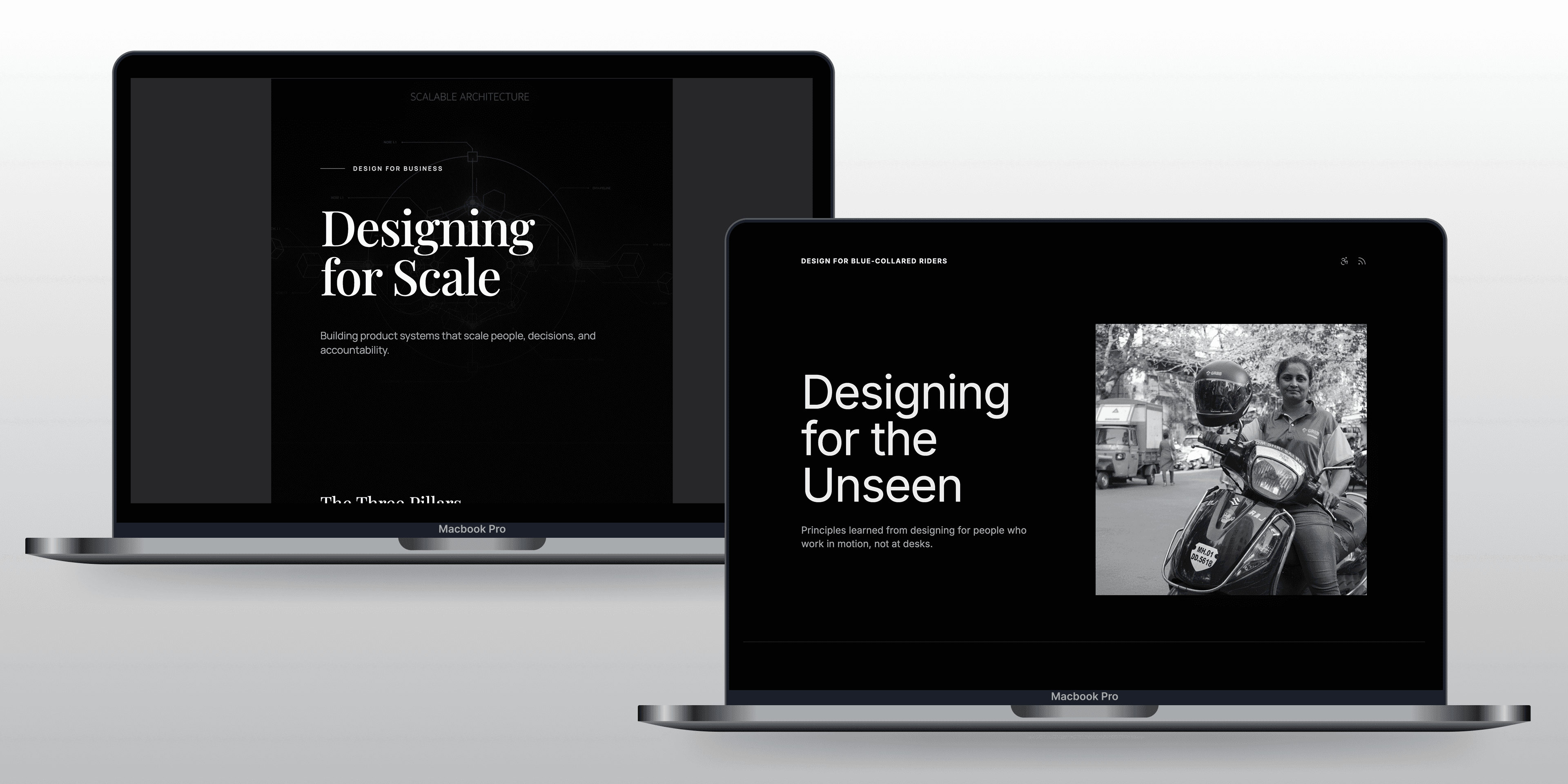
DESIGNING FOR THE UNSEEN
This site explores how products behave in real conditions—when users are in motion, under pressure, or operating with limited time, literacy, or attention. It focuses on the invisible moments that often decide success or failure: uncertainty, interruption, and recovery. Through real-world delivery and onboarding systems, the site shows how clarity, feedback, and context-aware decisions build trust at scale. This microsite is about designing for reality, not ideal usage.
DESIGNING FOR SCALE
Designing for Scale examines how systems hold up as complexity grows—across teams, markets, and operational load. It looks beyond screens to ownership models, decision frameworks, and visibility for leaders and operators. The work highlights how design shapes accountability, reduces risk, and enables predictable execution under pressure. This microsite is about ensuring growth doesn’t break clarity, responsibility, or outcomes.
Both microsites argue the same point: good design comes from understanding constraints deeply, then building systems that work within them—not around them. Whether those constraints are human (time, attention, environment) or organizational (teams, ownership, coordination), the discipline is identical: observe reality, document patterns, create infrastructure that makes the right choice the easy choice.